
Insights from PR Consultants Group’s Talking PR Podcast
By Jo Trizila, TrizCom PR & Pitch PR
4/6/2026
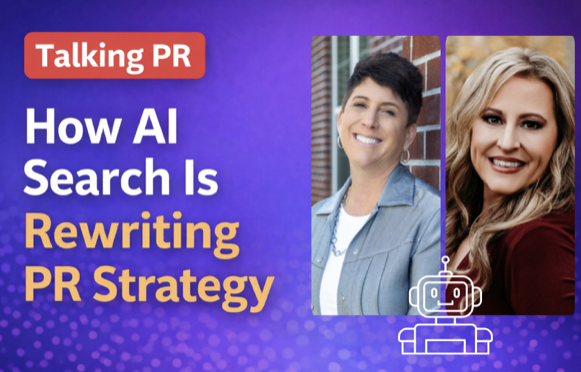
PR Consultants Group has launched its new podcast, Talking PR, bringing together senior communications leaders from across the country to examine the forces reshaping our profession. In Season 1 Episode 4: The AI Effect on Public Relations, Jennifer Regen Bisbee, APR, Fellow PRSA, Bisbee and Company, representing Orlando, Florida and Elizabeth Edwards, Volume PR and Engagement Science Lab, representing Denver, Colorado, explored how artificial intelligence is transforming the art and science of public relations.
Their conversation made one thing clear. AI answers are no click responses. It delivers answers. That shift is rewriting PR strategy in ways that demand executive attention.
Quick Takeaways from Talking PR
- AI search synthesizes answers instead of listing links.
- PR content feeds generative AI engines.
- Reputation management now includes auditing AI responses.
- Earned media influences AI trust signals.
- Ethical AI strategy is now a leadership priority.
What Is AI Search and Why Does It Matter to PR?
For years, digital visibility meant ranking on search engines. Users received a list of links, compared sources and formed their own opinions. Today, generative AI engines increasingly provide a summarized response. They read across websites, media coverage, press releases and commentary, then present a narrative in natural language.
As discussed on Talking PR, this changes the role of communications professionals in a profound way. We are no longer influencing only what journalists write. We are influencing what machines conclude.
Instead of asking, “Where do we rank?” leaders must now ask, “What conclusion is AI forming about our organization?” AI may describe what your company stands for, what your expertise appears to be and whether you are trustworthy. If those conclusions are incomplete or inaccurate, that is a strategic communications issue, not a technical glitch.
Why PR Now Feeds the Generative Engine
One of the most important insights from the podcast is that public relations activity directly influences AI outputs. Generative engines rely heavily on signals such as earned media coverage, wire-distributed press releases, authoritative third-party mentions, consistent positioning across platforms and structured question-based content.
PR has always focused on third-party credibility. Now that credibility shapes machine-generated answers. If there is a lack of independent validation, AI fills the gaps with whatever signal is strongest, even if it is limited or skewed. Inconsistent messaging or sparse coverage can lead to narrative drift that reshapes how a brand is presented.
Reputation Management in the Age of AI
The episode emphasized that AI search shapes belief, not just awareness. When users receive a confident AI-generated answer, many accept it at face value. Few dig through multiple sources to verify the summary. This accelerates perception formation and increases reputational risk.
Leadership teams should now conduct an AI reputation audit. Run prompts such as “What does our company specialize in?” Is our organization trustworthy? Who are the top firms in our category? How do we compare to competitors? Review the responses across multiple AI platforms and look for patterns. If AI is telling a different story than your strategy, your PR program must evolve to correct that gap.
How Small and Mid-Sized Businesses Can Compete
The conversation on Talking PR also highlighted an encouraging reality. AI can level the playing field. Generative search does not rely solely on advertising budgets. It synthesizes authority signals.
A regional healthcare provider, restaurant group, law firm or B2B consultancy that publishes clear, authoritative content supported by earned media can compete with national brands. Niche expertise, when documented consistently and credibly, can surface prominently in AI-generated answers. Clarity and consistency now matter more than scale alone.
SEO vs GEO: A Strategic Shift
Many communications professionals are now discussing Generative Engine Optimization, or GEO. This approach expands beyond traditional SEO and reflects the new realities of AI synthesis.
| Traditional SEO | GEO Strategy |
| Optimize for keywords | Optimize for narrative synthesis |
| Focus on rankings | Focus on inclusion in AI answers |
| Traffic-driven metrics | Authority-driven metrics |
| Page-level optimization | Cross-channel credibility signals |
| Click-through rates | Answer-level visibility |
SEO remains foundational because structured and crawlable content supports discoverability. However, ranking alone does not control how AI summarizes your brand. GEO integrates PR, content strategy and third-party validation to influence how generative engines interpret expertise and credibility.
Ethical Responsibility in an AI-Driven World
The podcast discussion also addressed the sobering side of this shift. AI outputs can be shaped quickly. Unsupported claims or loosely sourced data can influence machine responses, at least temporarily. That reality places greater responsibility on communications leaders.
Organizations should cite verifiable research, publish transparent data and avoid exaggerated claims. Internal AI usage guidelines are essential, especially when handling confidential information. Strategic influence must be paired with ethical discipline to protect long-term credibility.
How to Adapt Your PR Strategy Now
If you are leading communications or overseeing brand strategy, consider these immediate steps. Conduct a comprehensive AI visibility audit. Clarify your core positioning and ensure it is documented consistently. Align website messaging with strategic priorities. Develop natural language FAQ content that reflects real user questions. Secure earned media placements that reinforce authority. Distribute structured press releases through credible channels. Monitor AI outputs regularly and adjust strategy as needed.
Treat AI representation as infrastructure. It deserves the same executive oversight as financial performance or legal compliance.
Frequently Asked Questions
How does AI search impact public relations?
AI search impacts public relations by synthesizing information into direct narrative-style answers rather than presenting a list of links. PR efforts now influence how AI engines interpret and summarize a company’s credibility, expertise and positioning. Public relations plays a direct role in shaping the conclusions machines deliver to audiences.
Does SEO still matter in the age of AI search?
Yes, SEO remains important because AI systems still rely on structured and crawlable content. However, ranking alone is no longer enough to control brand narrative. Authoritative earned media and consistent third-party validation increasingly influence how AI summarizes a company’s reputation.
How can businesses influence what AI says about them?
Businesses can influence AI outputs by publishing clear positioning statements, distributing structured press releases and securing credible media coverage. AI engines prioritize consistent and authoritative signals across multiple sources. Regularly auditing AI responses ensures that synthesized narratives reflect the intended brand story.
What is generative engine optimization?
Generative Engine Optimization, or GEO, focuses on shaping how AI systems synthesize and present information about a brand. Unlike traditional SEO, which prioritizes rankings and traffic, GEO emphasizes narrative inclusion within AI-generated answers. It integrates PR, content strategy and authority-building to influence machine interpretation.
Is AI search a risk or an opportunity for small businesses?
AI search presents both risk and opportunity. Without consistent, authoritative content, small businesses may be mischaracterized or overlooked. However, organizations that clearly define their expertise and secure strong third-party validation can compete effectively, often outperforming larger competitors that lack focused positioning.
Ready to Strengthen Your AI-Era PR Strategy?
AI is already shaping how your organization is perceived. The question is whether you are guiding that narrative or leaving it to chance.
PR Consultants Group is an exclusive nationwide network of senior communications and marketing professionals representing diverse disciplines in every major U.S. market and beyond. Since 2000, members have collaborated to amplify impact for clients by combining national strength with local expertise.
If you are ready to audit how AI is describing your organization, refine your positioning and build a PR strategy designed for generative search, start the conversation today.
Contact PR Consultants Group at https://www.prconsultantsgroup.com/ and connect with a senior communications leader in your market.
About Talking PR
Talking PR is the official podcast of PR Consultants Group, an exclusive nationwide network of senior communications and marketing professionals representing diverse disciplines in every major U.S. market and beyond. Since 2000, members have collaborated to amplify impact for clients by combining national strength with local expertise. The podcast features real-world insights from seasoned PR leaders across the country. Learn more at https://www.prconsultantsgroup.com/
About the Participants:
Jennifer Regen Bisbee, APR, Fellow PRSA
Jennifer Regen Bisbee, APR, Fellow PRSA, is an award-winning public relations professional with four decades of experience serving globally recognized brands, industry-leading organizations and entrepreneurial startups. She is the founder and president of Bisbee and Company, Inc., an Orlando-based PR and integrated marketing communications firm with national capabilities. Connect with Jennifer at (407) 257-4667 or jennifer@bisbeeandco.com.
Elizabeth Edwards
Volume PR & Engagement Science Lab
Volume PR is a 22-year award-winning collective of expert communicators, business strategists, behavioral scientists, publicists, and marketers who accelerate awareness and growth for dynamic brands, worthy causes, and complex issues. Then, through our sister agency, Engagement Science Lab, we give you the keys to change your words and our world. Connect with Elizabeth at (720) 529-4850 or elizabeth@volumepr.com
About the Author:
Jo Trizila, Founder & CEO, TrizCom Public Relations
Jo Trizila leads Dallas-based TrizCom PR, an award-winning digital public relations agency she founded in 2008. She has guided integrated PR programs for startups, middlemarket companies and national brands, with deep experience in crisis communications, expert positioning and data-driven media strategy. Jo is also the creator of Pitch PR, a press release distribution company and a frequent speaker on earned media ROI, including sessions at the Earned Media Mastery virtual summit. Connect with Jo at (214) 232-0078 or jo@trizcom.com.